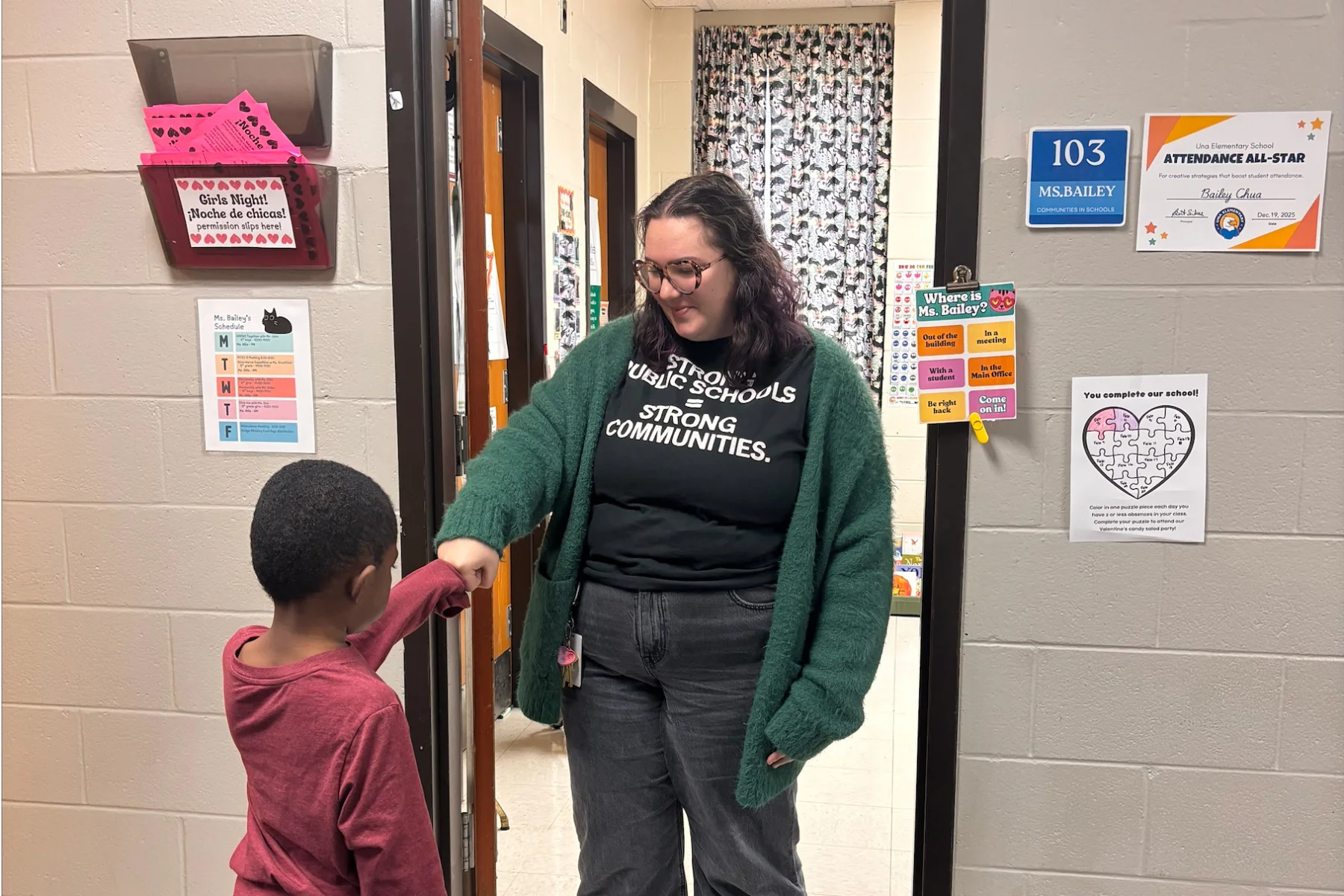
Bailey Chua spent many mornings at Una Elementary waiting for Alex. In the cold, in the heat of summer. In the rain. Bailey was there until he stepped off the bus so she could greet him.
“I have one boy who I’ve been working with since last year, and he’s in fourth grade now. He’s been chronically absent since he was in kindergarten,” said Bailey.
Bailey Chua is a program manager for Communities In Schools of Tennessee (CISTN) at Una Elementary. She’s the type of ‘mentor’ students want to visit during bathroom breaks and off hours. She’s got a big comfy couch in her room, snacks, and a warm, welcoming personality.
“It was hard last year. [Alex] still missed a lot of days. He was still struggling behaviorally and academically,” said Bailey. “Just between him moving around a lot, and then he just would never come to school, and it was hard to reach the parents. He had so many behavior issues. He was so behind academically.”
The name and gender of the student were not provided by Communities In Schools and were randomly selected to protect the student’s privacy.
During her interview with CFMT, Bailey spoke about Alex with the kind of fondness with which one speaks about family members they love or teachers who helped them to great success. The latter of which probably rings true for Alex, as he is a key example of how Communities In Schools is reaching students who may need more support than a school can provide on its own.
 Communities In Schools of Tennessee (CISTN) partners directly with public schools to surround students with practical and emotional support so they can stay focused on learning. Through formal agreements with districts, CIS places trained program managers, like Bailey, inside school buildings every day. These site coordinators work alongside teachers and administrators to identify students facing barriers to attendance, behavior, or academic success, and then connect them to resources such as mentoring, basic needs assistance, family outreach, and community services.
Bailey’s office, throughout the year, is a treasure trove of items that are necessary for kids to feel like themselves: winter coats, sacks of food, and sticks of deodorant. Things that aren’t toys or games but will still bring a smile.
You wouldn’t be completely wrong to think Bailey is running an impromptu sort of supermarket for elementary schoolers. And in a way, she is, but students can take anything they need for free. No questions asked.
As a program manager, Bailey is innately curious about students and how their day is going. It’s part of the job. She has a list of kiddos she works with, but is welcoming to all. She’s kind. Friendly.
But most importantly, she’s persistent.
“‘I tell my kids, I’m going to annoy you with how much I check in on you, and you’re going to love it’. I’ll come and look for them when they get off the bus every day and say, ‘I’m so glad you’re here today.’”
Adolescence, and especially the elementary years, present their own slew of challenges, enough to make any youngster feel caught in a whirlwind of academic expectations, social pressures, and feelings of inadequacy. In a world of bubble gum and sneezes, state tests and playground games – don’t kids have enough to worry about without thinking about whether they’ll eat tonight? Or if someone will poke fun at them for their clothes not smelling too clean or their shoes being too worn?
“Food, hygiene, clothes, just really all of that basic stuff,” said Bailey. “It’s what you need to feel comfortable and healthy and happy by the time you walk through the school doors.”
Bailey and the other program managers of Communities In Schools are working to make sure students can focus on thriving as kids. Not worrying about when their next meals will come or if they need to keep wearing old clothes.
“On average, two-thirds of the barriers to a student’s academic success are actually non-academic,” said Kara Sherrer. “Teachers already have a lot on their plates. They may not have the ability to step in and address those other challenges, and that’s where Communities in Schools program managers come in.”
After nearly twelve years of working in Middle Tennessee, Communities is still expanding throughout the region. It lives up to its namesake as well. Without each other, how can we expect the next generation of leaders and innovators to build a better future?
“They know that someone is actually looking out for them, and it completely changes the way they see school,” said Bailey. “I want people to think about how they can support their community. Find your nearest elementary school and ask, ‘How can I help?’. How can I support a student?” Alex’s trust in Bailey grew until one day their dynamic reversed. Bailey didn’t need to look for Alex. He was looking for her.
It was an expectation she was going to be there. Bailey had shown Alex that he could trust and rely on her – a cornerstone to start his day. It made all the difference.
“Just knowing that someone is checking in on them absolutely changes the way they see school. It’s taken almost a year, but it’s the constant checking in that makes the difference,” said Bailey.
It’s not just Alex. Bailey has many students who she shows up for in this way. Bailey is one of many program managers who are working across Middle Tennessee to provide students with a community who truly cares about them.
When Bailey was asked about how she wants people to react who learn about how necessary this work is, she said:
“I want them to think about how they can support their community. Find your nearest elementary school, call them up, and say, ‘Do you need snacks? Do you need time? Do you need someone to come and read to kids or show books in the library?’ How can I help? How can I impact a student?”
And for Alex, that steady kind of showing up is starting to change what’s possible. In the fall, he was missing school often and struggling, reading 14 words per minute. By January, he hadn’t missed a day since early October. He was named CIS Student of the Month, with his reading benchmark jumping to 45 wpm.
From clothing, to necessary hygiene supplies, Communities In Schools is providing services that allow kids to be kids. And Bailey will continue to welcome students to sit on her comfy couch, to provide deodorant to students who need it, and yes:
Bailey will continue to wait for Alex to get off the bus, give him a high five, and get ready to start their day.
Communities In Schools is a Community Impact Grantee of Community Foundation of Middle Tennessee. CFMT’s Community Impact Grants support work across Arts and Creative Culture, Child and Youth Development and Education, and Positive Mental Health, strengthening belonging and well-being across the region.